
Blocky proline/glutamine patterns in the SFPQ intrinsically disordered region dictate paraspeckle formation as a distinct membraneless organelle
A research team at the University of Osaka has identified a novel amino acid sequence pattern that dictates paraspeckle independence within the nucleoplasmic environment.
| Journal | RNA 32 (5), 688-703 (2026) |
|---|---|
| Title | Blocky proline/glutamine patterns in the SFPQ intrinsically disordered region dictate paraspeckle formation as a distinct membraneless organelle |
| Laboratory | RNA Biofunction Laboratory〈Prof. HIROSE Tetsuro〉 |
Abstract
Membraneless organelles formed through liquid–liquid phase separation play essential roles in a wide range of intracellular processes. Many MLOs maintain their independence within the crowded cellular environment by avoiding fusion with or engulfment by neighboring MLOs. While MLOs are known to be formed through dynamic multivalent interactions mediated primarily by proteins containing IDRs, the molecular principles by which already formed MLOs preserve their independence have remained poorly understood.
In this study, the researchers at The University of Osaka focused on SFPQ, an RNA-binding protein previously identified by the group as a factor responsible for separating paraspeckles from another MLO, the nuclear speckle. They analyzed the function of a proline/glutamine (P/Q)-rich IDR within SFPQ. By examining whether paraspeckles tethered with SFPQ mutants at their surface could remain segregated from nuclear speckles, the researchers demonstrated that P/Q residues within the SFPQ IDR—highly conserved among vertebrates—are essential for this segregation activity.
Importantly, the results revealed that not only the overall amino acid composition, but also a "P/Q blocky sequence pattern," in which proline-rich blocks and glutamine-rich blocks are arranged repetitively, is required for segregation from nuclear speckles. Furthermore, molecular dynamics simulations suggested that this P/Q blocky sequence pattern counteracts the self-assembly properties of IDRs. Similar P/Q blocky sequence patterns were found in various regulatory factors other than SFPQ, indicating that this IDR sequence pattern may contribute to MLO independence through a mechanism distinct from the conventional phase separation–promoting functions previously described.
These findings provide fundamental insights into the intracellular behavior and functional regulation of phase-separated MLOs and are expected to make significant contributions to the life sciences and medical research fields, including the development of therapeutic strategies targeting MLOs.
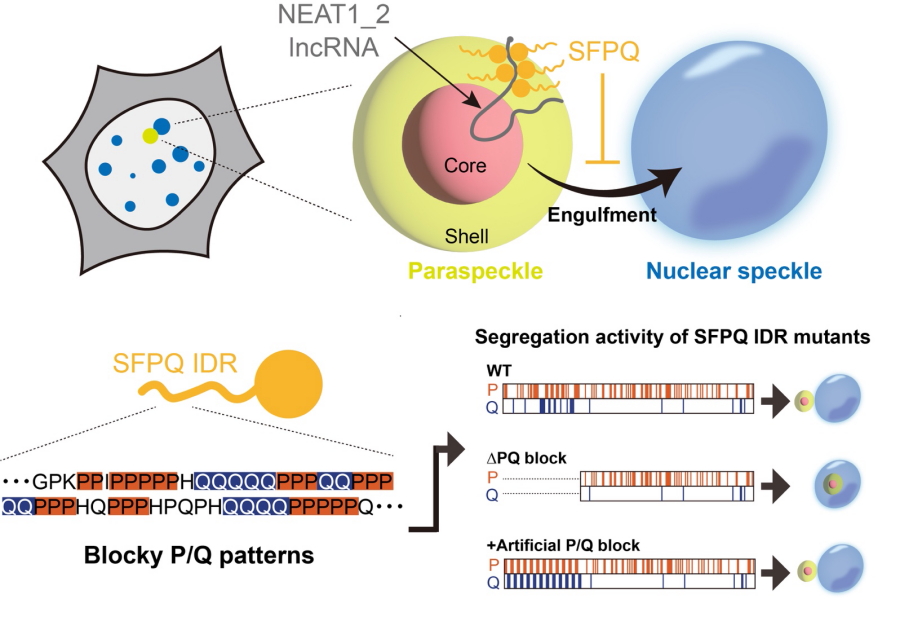
Fig. 1
SFPQ maintains paraspeckle independence by preventing their engulfment by nuclear speckles, via accumulation of its blocky P/Q-patterned IDR within the paraspeckle shell.
| Authors | Hiro Takakuwa (1), Takao Yoda (2), Tomohiro Yamazaki (1, 3), Tetsuro Hirose (1, 3, 4)
|
|---|---|
| PubMed | 41571439 |


