
Integrated Biology Laboratories
Laboratory for Developmental Epigenetics
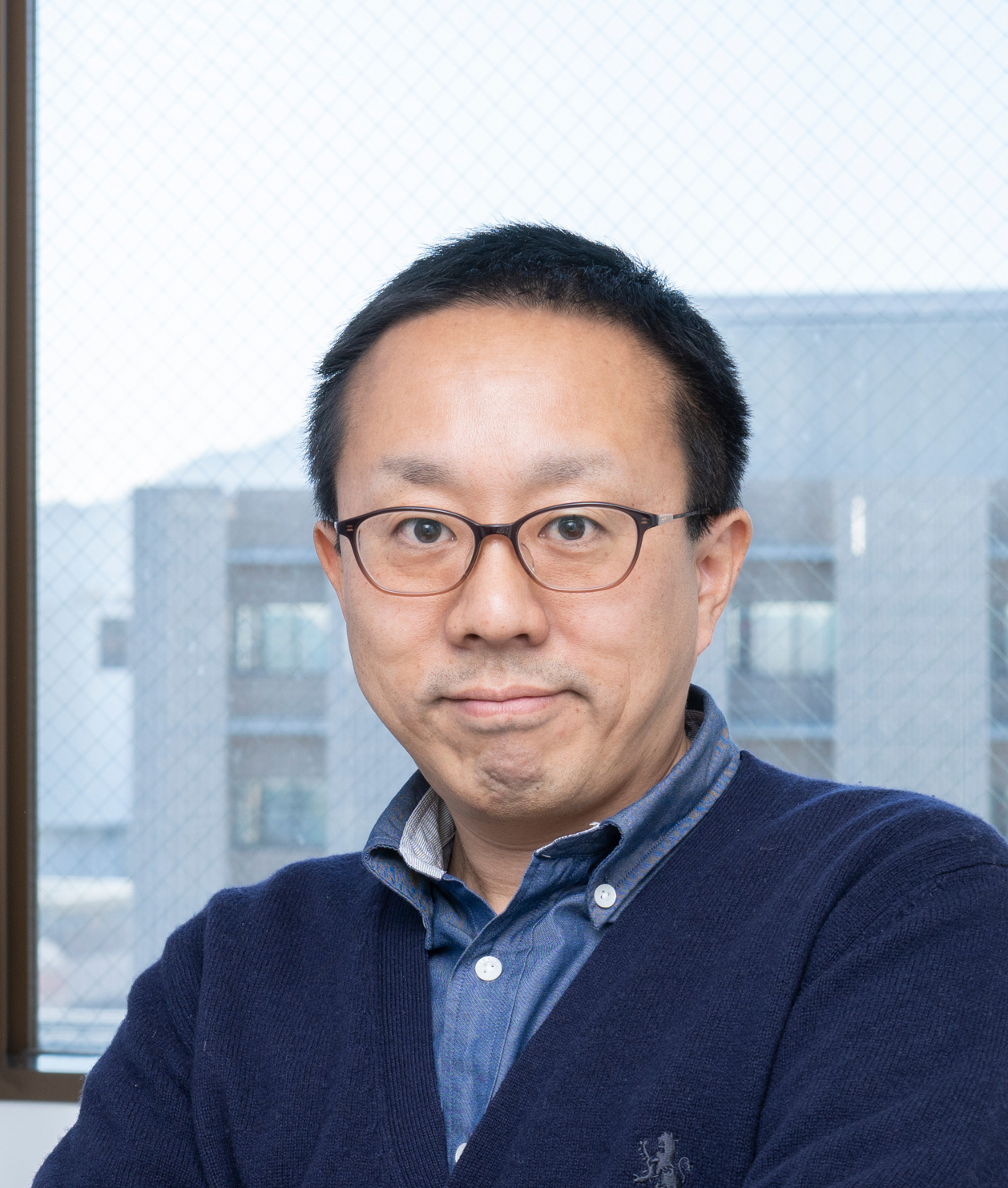 Prof. HIRATANI Ichiro
Keywords:
3D genome organization, DNA replication, Development/Differentiation, Single-cell genomics
Unraveling the principles of genome regulation through DNA replication and 3D genome organization
Members
| HIRATANI Ichiro (Professor) | hiratani.ichiro.fbs[at]osaka-u.ac.jp |
|---|
You could probably reach more information of individual researchers by Research Map and researcher's search of Osaka-U.
- ※Change [at] to @
Q&A
- What is your hot research topic?
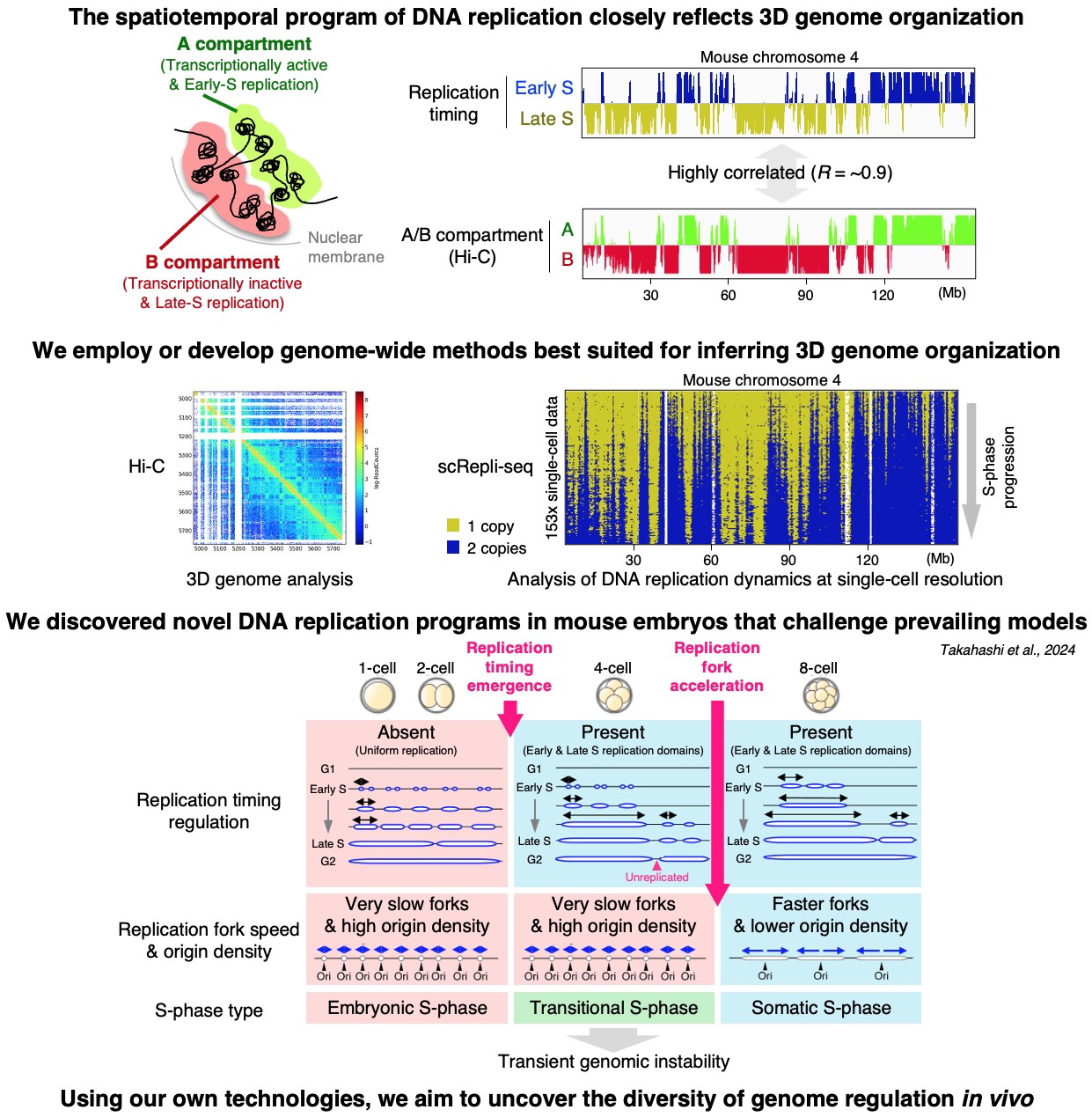
- I am interested in understanding how three-dimensional (3D) genome organization, which underlies various genome functions including gene expression, is spatiotemporally regulated. We approach this question through the lens of DNA replication timing, which is closely linked to 3D genome organization. Our studies have revealed that both 3D genome organization and DNA replication control exhibit remarkable plasticity across developmental stages and cell types, and that these changes are strongly coordinated, suggesting that the two processes may themselves be coordinately regulated. Moving forward, with a particular focus on early mouse embryos, we aim to uncover the molecular basis and biological significance of this flexibility and coordination, and ultimately understand how diverse cell types properly execute genome functions while stably maintaining and transmitting their genomes.
- Have you had any breakthroughs or significant research progress in the last 5 years?
- Together with our collaborators, we extended the genome-wide DNA replication timing profiling method I had previously developed to establish scRepli-seq, a single-cell DNA replication sequencing method, in 2019 (Takahashi et al., Nat Genet 2019). This unique approach enables us to characterize DNA replication dynamics during development and differentiation at the single-cell level and to infer changes in 3D genome organization from these dynamics. Using ES cell differentiation, early mouse embryogenesis, and X-chromosome inactivation as model systems, we have discovered that DNA replication control is far more diverse and flexible than previously thought (Miura et al., Nat Genet 2019; Poonperm et al., Nat Struct Mol Biol 2023; Takahashi et al., Nature 2024). More recently, we found that the establishment of orderly 3D chromosome organization at the G1/S transition after cell division plays an important role in controlling DNA replication in the subsequent S phase (Oji et al., Nat Commun 2026).
- What kind of background do your lab members have?
- Many of our members have backgrounds in the life sciences, but we also have people with different academic backgrounds as well as members from overseas, making us a diverse research group. Our research combines a variety of approaches, ranging from experimental biology to genomics and bioinformatics.
- Do you collaborate with other institutions and universities?
- We collaborate with many laboratories in Japan and around the world through joint research projects. In addition to large scientific conferences, we actively participate in small- to medium-sized research meetings, which I personally enjoy the most! We also organize such meetings ourselves. More recently, we have been building connections with researchers in epigenetics and genome biology across Asia, including by organizing international scientific meetings.
- What kind of careers do your lab's alumni go on to?
- Many of our former members have pursued careers in academia, taking positions such as university faculty members and postdoctoral researchers at institutions overseas, while others have gone on to PhD programs. Each has followed a path that reflects their own interests and career goals.
- How do you develop your research?
- I continue to be fascinated by the depth of genomes and chromosomes. By combining our unique technologies with the flexible and creative ideas of young researchers, I hope to deepen our understanding of genomes and chromosomes, which carry our genetic information. I am excited to see what new and interesting directions will emerge from our research, whether in basic science, applied research, or technology development.
Research Highlights
Publications (Research Articles, Reviews, Books)
2026
Cell-cycle-resolved Hi-C reveals unexpected plasticity of A/B compartments across interphase.
eLife 15, RP110073 2026 ( DOI:10.7554/eLife.110073)
Single-cell mapping of chromosome breaks identifies multiple fragile site classes with distinct DNA replication timing landscapes.
Nat Commun 17, 9055 2026 (PMID:42778573 DOI:10.1038/s41467-026-76451-1)
Nuclear compartmentalization at the G1/S transition plays a key role in DNA replication control.
Nat Commun 17, 6961 2026 (PMID:42575893 DOI:10.1038/s41467-026-75264-6)
Regulation of DNA replication and 3D genome organization during early embryogenesis.
Curr Opin Genet Dev 98, 102469 2026 (PMID:41955751 DOI:10.1016/j.gde.2026.102469)
2025
scRepli-RamDA-seq: a multi-omics technology enabling the analysis of gene expression dynamics during S-phase.
Nat Commun 16, 10902 2025 (PMID:41397953 DOI:10.1038/s41467-025-64688-1)
2024
Embryonic genome instability upon DNA replication timing program emergence.
Nature 633, 686-694 2024 (PMID:39198647 DOI:10.1038/s41586-024-07841-y)
2023
Replication dynamics identifies the folding principles of the inactive X chromosome.
Nat Struct Mol Biol 30, 1224-1237 2023 (PMID:37563439 DOI:10.1038/s41594-023-01052-1)
2020
Mapping replication timing domains genome wide in single mammalian cells with single-cell DNA replication sequencing.
Nat Protoc 15, 4058-4100 2020 (PMID:33230331 DOI:10.1038/s41596-020-0378-5)
2019
Single-cell DNA replication profiling identifies spatiotemporal developmental dynamics of chromosome organization.
Nat Genet 51, 1356-1368 2019 (PMID:31406346 DOI:10.1038/s41588-019-0474-z)
Genome-wide stability of the DNA replication program in single mammalian cells.
Nat Genet 51, 529-540 2019 (PMID:30804559 DOI:10.1038/s41588-019-0347-5)
Contact
Graduate School of Frontier Biosciences, Osaka University,
1-3 Yamadaoka, Suita, Osaka 565-0871 Japan
E-mail: hiratani.ichiro.fbs[at]osaka-u.ac.jp (Prof. Ichiro Hiratani)
- ※Change [at] to @


