FBS Colloquia No.414Laboratory of Functional Genomics for Human Evolution
| Seminar or Lecture |
"Uncovering the Genomic Foundations of Human Uniqueness” Ikuo K. Suzuki [Professor, Laboratory of Functional Genomics for Human Evolution] |
|---|---|
| Date and Time | 26 May 2026 (Tue), 12:15-13:00 |
| Place | 2F Seminar Room, BioSystems Building |
| Language | Japanese |
| Contact |
Ikuo K. Suzuki (Professor) |
"Uncovering the Genomic Foundations of Human Uniqueness”
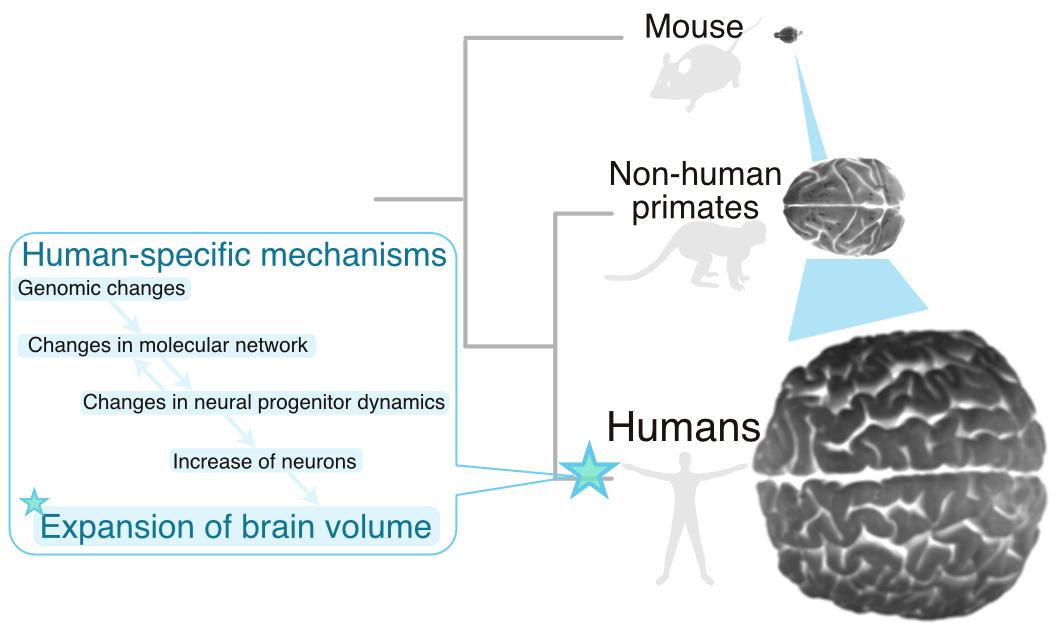
I am Ikuo Suzuki, and I am honored to have joined the Graduate School of Frontier Biosciences (FBS) as a professor this April. Having recently established the "Laboratory of Functional Genomics of Human Evolution," I look forward to engaging with the diverse research community here at FBS and developing new collaborative projects. Our research is driven by a fundamental question: What biological mechanisms determine the defining characteristics of a species? We are particularly fascinated by the uniqueness of the human species, specifically the dramatic expansion of the cerebral cortex—the biological bedrock of human-specific traits such as language and complex intelligence. Since brain size is primarily determined by the number of neurons generated during development, identifying the genetic programs that control neuronal output is the core of our investigation. A key focus of our work is "human-specific genes." While gene regulatory evolution is undeniably important, genes that were newly acquired during the human lineage play an equally vital role. For instance, we previously identified NOTCH2NL, a human-specific gene highly expressed in fetal neural progenitors, which increases neuron production by modulating developmental timing. Thousands of such human-specific genes likely exist in our genome, yet many remain functionally uncharacterized. In our laboratory, we employ a multidisciplinary approach to decode these hidden genomic instructions:
1) Integrative Bioinformatics: Using the latest genomic datasets to comprehensively identify human-specific genes across various evolutionary mechanisms.
2) Functional Validation via Human Organoids: Utilizing our established experimental system—featuring long-term (1 month+) time-lapse imaging of neural progenitors—to track entire lineages and verify how candidate genes alter the dynamics of neuron production.
3) Comparative Developmental Biology: Directly comparing human and ape brain organoids, as well as studying structural brain differences among rodents, to distinguish between evolutionarily conserved programs and those susceptible to evolutionary modification.
In this seminar, I will present our recent findings and discuss the future directions of our research at FBS. I look forward to stimulating discussions with colleagues from various fields, including cell biology, evolution, genomics, and neuroscience.