
Integrated Biology Laboratories
Laboratory of Targeted Protein Degradation
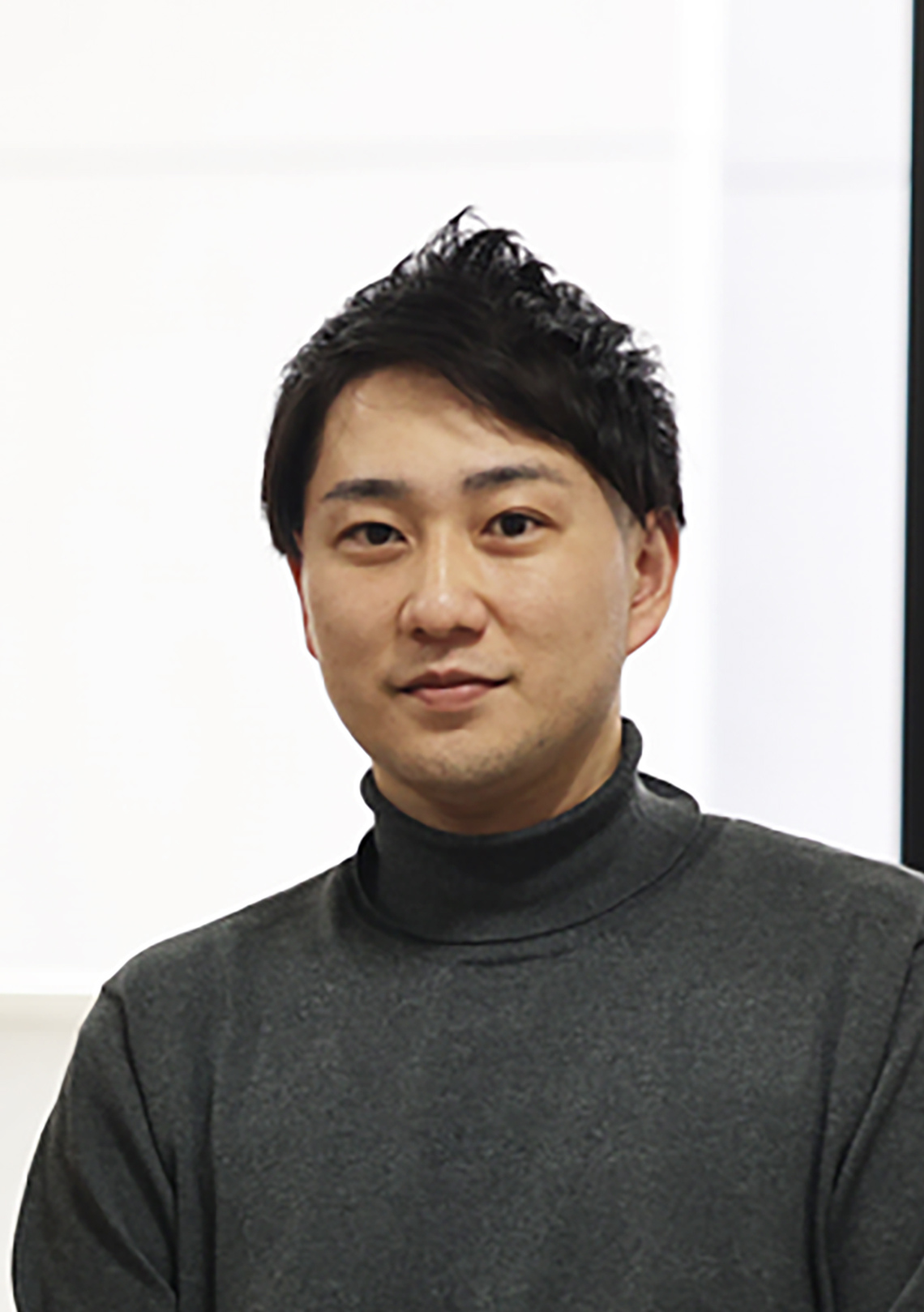 Assoc. Prof. YAMANAKA Satoshi

Keywords:
Targeted Protein Degradation, Ubiquitin Ligases, Protein–Protein Interactions, Protein Degraders, Proximity Labeling, Drug Discovery
We elucidate the molecular mechanisms of protein degradation to drive next-generation drug discovery.
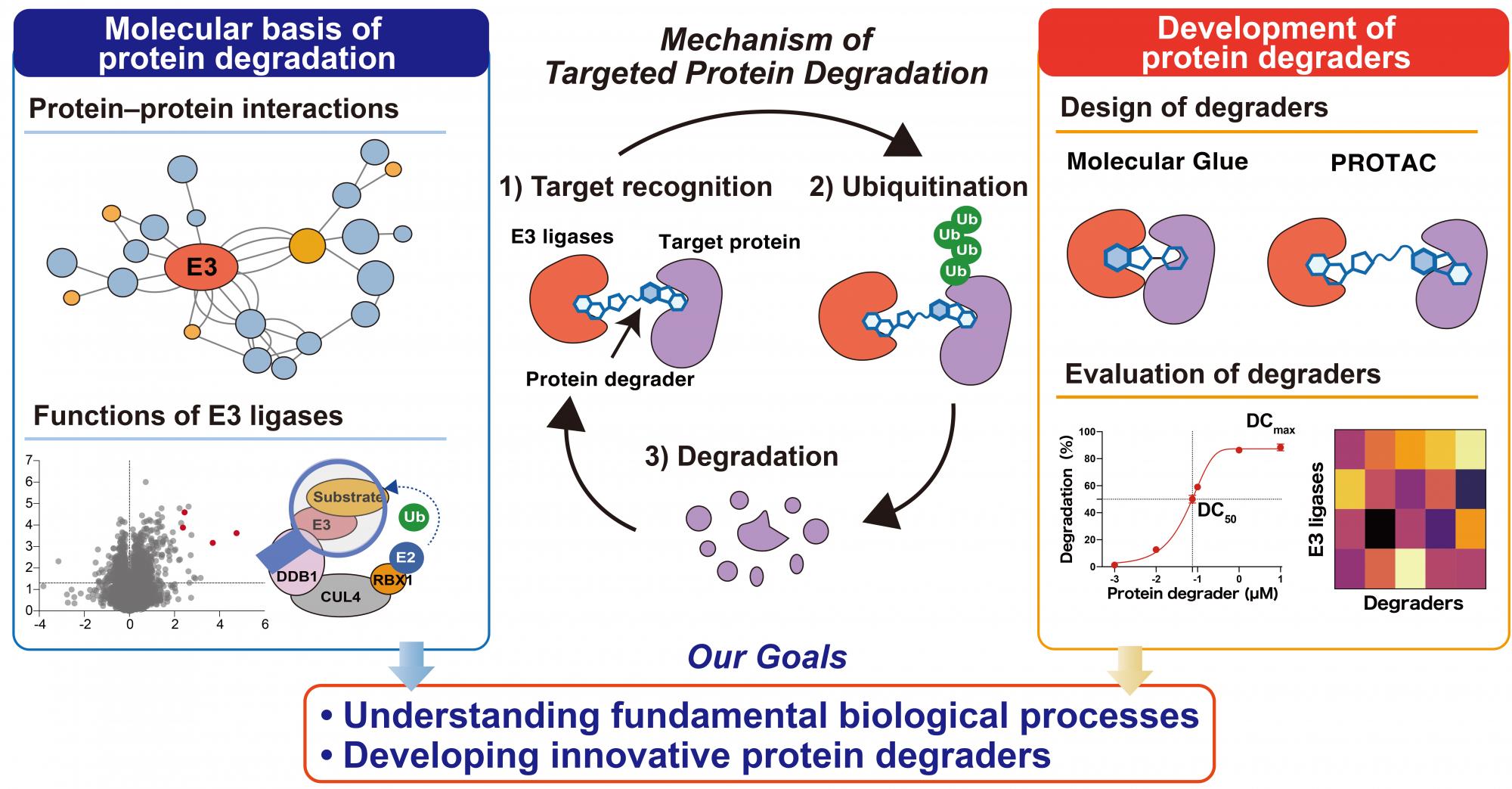
Schematic illustration of our research concept, highlighting the molecular mechanisms of protein degradation, the analysis of targeted protein degradation (TPD), and the development of protein degraders.
Members
| Satoshi Yamanaka (Associate Professor) | yamanaka.satoshi.fbs[at]osaka-u.ac.jp |
|---|
You could probably reach more information of individual researchers by Research Map and researcher's search of Osaka-U.
- ※Change [at] to @
Q&A
- What is your hot research topic?
- We focus on targeted protein degradation (TPD). E3 ubiquitin ligases confer substrate specificity to the ubiquitin–proteasome system by promoting the ubiquitination of target proteins and directing them for degradation. TPD harnesses this cellular machinery to selectively eliminate disease-associated proteins. Our research integrates fundamental biology aimed at elucidating the molecular mechanisms of protein degradation with drug discovery aimed at translating these insights into novel protein degraders.
- Have you had any breakthroughs or significant research progress in the last 5 years?
- We have focused on protein–protein interactions induced by protein degraders and employed our original analytical techniques to elucidate their mechanisms of action and E3 ubiquitin ligase functions. Recently, we focused on the DCAF family—a major class of E3 ubiquitin ligases exploited in targeted protein degradation. We characterized the E3 ubiquitin ligase activities, interacting proteins, and previously unrecognized substrates of individual DCAFs, thereby establishing a foundation for investigating unexplored E3 ubiquitin ligases from the perspectives of both fundamental biology and drug discovery.
- What kind of background do your lab members have?
- We integrate diverse research fields, including protein science, molecular and cell biology, and chemical biology.
- Do you collaborate with other institutions and universities?
- We collaborate with academic institutions and industry partners in Japan and abroad, integrating complementary expertise in chemical synthesis, proteomics, drug discovery, and related fields.
- What kind of careers do your lab's alumni go on to?
- As our laboratory is newly established, we have not yet had any graduates. Looking ahead, we aim to foster researchers who can pursue diverse career paths in academia, the pharmaceutical and biotechnology industries, and related fields.
- How do you develop your research?
- We aim to expand the potential of targeted protein degradation through a two-pronged approach: advancing fundamental biology to uncover unexplored E3 ubiquitin ligases and novel degradation mechanisms, and driving drug discovery to translate these findings into new protein degraders.
Research Highlights
Publications (Research Articles, Reviews, Books)
2026
An interactome-based framework for DDB1- and CUL4-associated factor prioritization in targeted protein degradation
Molecular Cell 86(7): 1397-1416 2026 (PMID:41932313 DOI:10.1016/j.molcel.2026.03.004)
An Alkyne Two-Phase Strategy: Rapid Generation of TK-285-Derived PROTACs as BRD4 Degraders
Journal of Medicinal Chemistry 69(7): 8388-8416 2026 (PMID:41852276 DOI:10.1021/acs.jmedchem.5c03771)
2025
In-cell proximity target validation methods for heterobifunctional molecules with CRBN- or VHL-binder using AirID
Communications Biology 8(1): 13238 2025 (PMID:40885760 DOI:10.1038/s42003-025-08761-x)
2024
Cell-type specific, inducible and acute degradation of targeted protein in mice by two degron systems
Nature Communications 15(1): 10129 2024 (PMID:39613744 DOI:10.1038/s41467-024-54308-9)
2023
Lenalidomide derivatives and proteolysis-targeting chimaeras for controlling neosubstrate degradation
Nature Communications 14(1): 4683 2023 (PMID:37596276 DOI:10.1038/s41467-023-40385-9)
2022
A proximity biotinylation-based approach to identify protein-E3 ligase interactions induced by PROTACs and molecular glues
Nature Communications 13(1): 183 2022 (PMID:35013300 DOI:10.1038/s41467-021-27818-z)
CF-PPiD technology based on cell-free protein array and proximity biotinylation enzyme for in vitro direct interactome analysis
Scientific Reports 12(1): 10592 2022 (PMID:35732899 DOI:10.1038/s41598-022-14872-w)
2021
Thalidomide and its metabolite 5-hydroxythalidomide induce teratogenicity via the cereblon neosubstrate PLZF
EMBO Journal 40(4): e105375 2021 (PMID:33470442 DOI:10.15252/embj.2020105375)
2020
An IMiD-induced SALL4 degron system for selective degradation of target proteins
Communications Biology 3(1): 515 2020 (PMID:32948804 DOI:10.1038/s42003-020-01240-5)
Structural bases of IMiD selectivity that emerges by 5-hydroxythalidomide
Nature Communications 11(1): 4578 2020 (PMID:32929090 DOI:10.1038/s41467-020-18488-4)
AirID, a novel proximity biotinylation enzyme, for analysis of protein-protein interactions
eLife 9: e54983 2020 (PMID:32391793 DOI:10.7554/eLife.54983)
Subiquinocin, a small molecule inhibitor of CYLD and USP family deubiquitinating enzymes, promotes NF-ホコB signaling
Biochemical and Biophysical Research Communications 524(1): 1-7 2020 (PMID:31898971 DOI:10.1016/j.bbrc.2019.12.049)
Contact
Graduate School of Frontier Biosciences, Osaka University,
1-3 Yamadaoka, Suita, Osaka 565-0871 Japan.
E-mail: yamanaka.satoshi.fbs[at]osaka-u.ac.jp (Assoc. Prof. Satoshi Yamanaka)
- ※Change [at] to @


