α,β,の推定
観測された(CTを考慮に入れた)FRETratioでは各蛍光色素の吸光係数,フィルタ幅などを考慮していません.
したがって,各チャンネルの蛍光強度から,それぞれの蛍光色素の発する割合を考えなくてはならない.
考慮すべき点は,
励起した波長がどの程度の効率か?(ExCFP, ExYCFP)
全蛍光のうち,どの程度の範囲をフィルターで取得しているのか? (AECFP, AEYFP)
各蛍光色素の分子吸光係数,量子収率はどれくらいか? (ECCFP, ECYFP, QYCFP, QYYFP)
を考慮に入れる必要があります.
・CFP
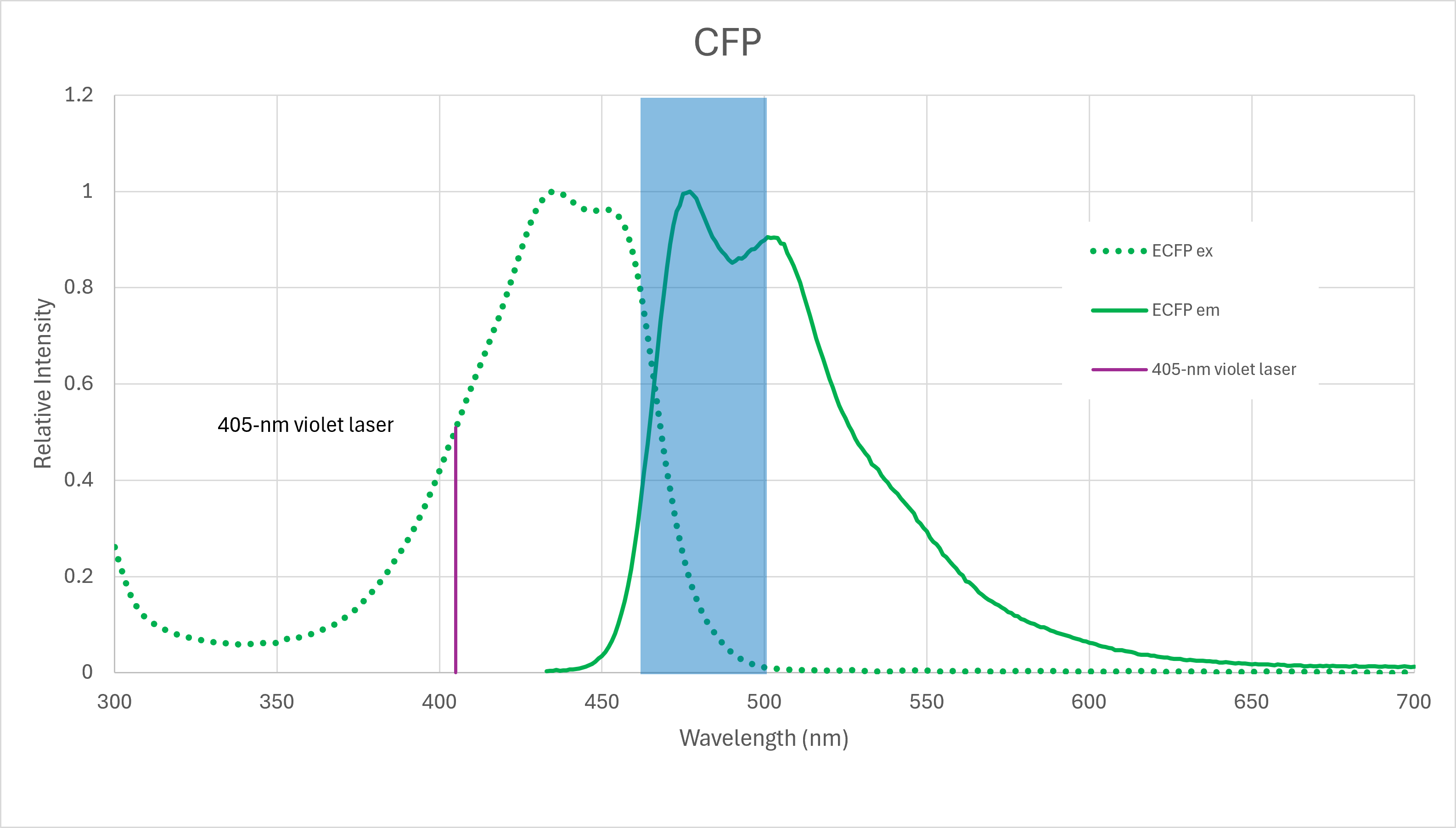
CFPの励起・蛍光スペクトルと,励起レーザー,蛍光フィルターとの関係は,
となります.
したがって, 405 nmレーザーで励起しているので,
励起した波長がどの程度の効率か?
\(\Large Ex_{CFP} = 0.51 \)
となります.
全蛍光のうち,どの程度の範囲をフィルターで取得しているのか?
\(\Large AE_{CFP} = \frac{\displaystyle \int_{447}^{499} Em_{CFP} (\lambda) \ d \lambda}{\displaystyle \int_{0}^{ \infty} Em_{CFP} (\lambda) \ d \lambda } = 0.49 \)
蛍光色素の分子吸光係数,量子収率はどれくらいか?
は,
分子吸光係数 ( ECCFP ):32,500
量子収率 ( QYCFP ):0.40
となるので(FPbaseより),CFPの蛍光(モル濃度), ( FICFP )は,
\(\Large FI_{CFP} = EC_{CFP} \times QY_{CFP} \times Ex_{CFP} \times AE_{CFP} \)
\(\Large = 32,500 \times 0.40 \times 0.51 \times 0.49 = 3,249 \hspace{40pt} (13) \)
となります.後で比を求めるので,単位は気にしなくていいです.
・Venus
Venusの励起・蛍光スペクトルと,励起レーザー,蛍光フィルターとの関係は,
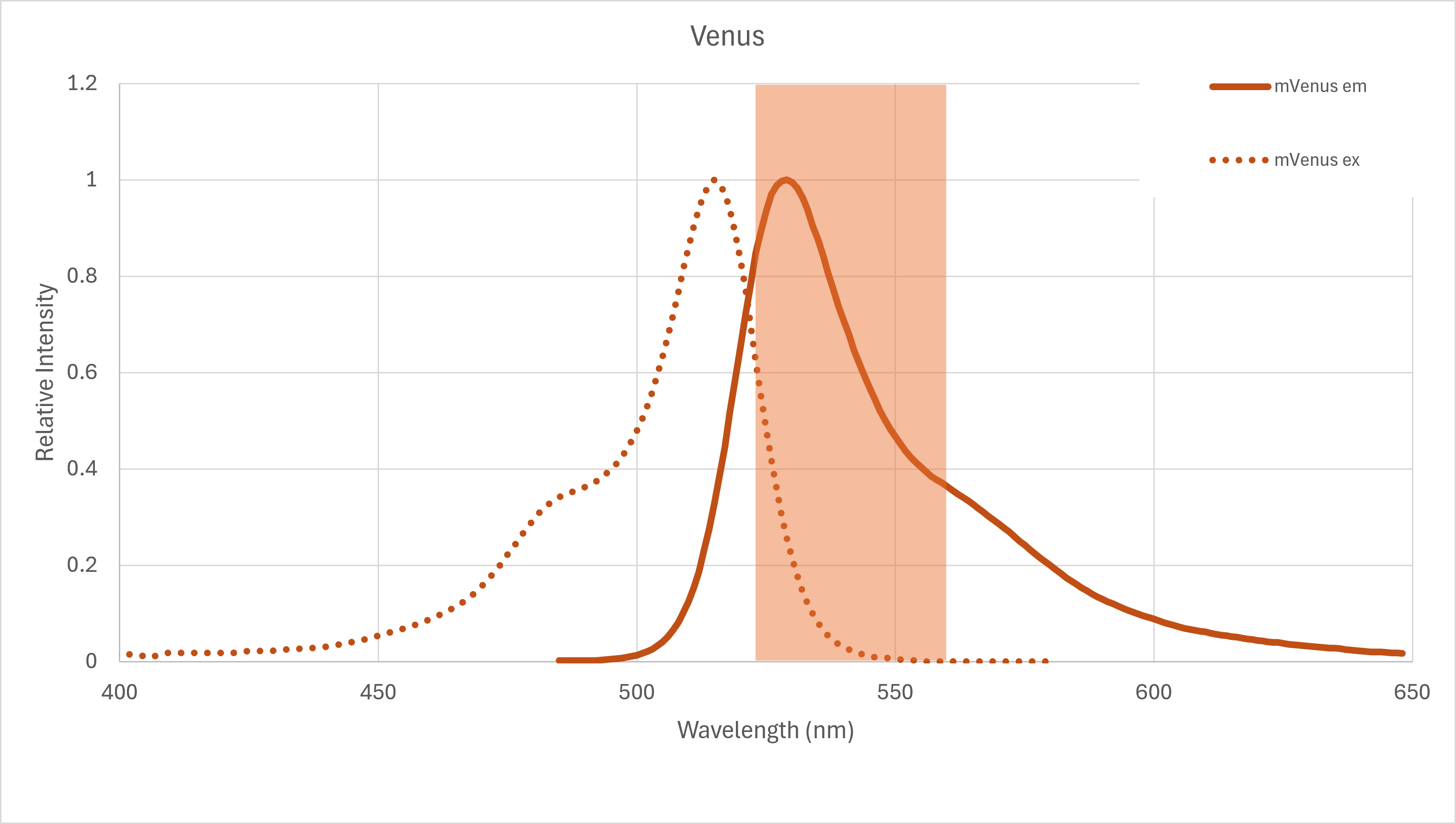
となります.
405 nmレーザーで励起されたCFPがCFPの蛍光波長帯で蛍光特性を示し,それに対して,Venusが励起されるので,
励起した波長がどの程度の効率か?
\(\Large Ex_{Venus} = \frac{\displaystyle \int_{- \infty}^{ \infty} Em_{CFP} (\lambda) \times Em_{Venus} (\lambda)\ d \lambda}{\displaystyle \int_{- \infty}^{ \infty} Em_{CFP} (\lambda) \ d \lambda } = 0.43 \hspace{40pt} (14) \)
となります.
全蛍光のうち,どの程度の範囲をフィルターで取得しているのか?
\(\Large AE_{Venus} = \frac{\displaystyle \int_{526}^{559} Em_{Venus} (\lambda) \ d \lambda}{\displaystyle \int_{0}^{ \infty} Em_{Venus} (\lambda) \ d \lambda } = 0.54 \)
蛍光色素の分子吸光係数,量子収率はどれくらいか?
は,
分子吸光係数 ( ECVenus ):104,000
量子収率 ( QYVenus ):0.64
となるので(FPbaseより),Venusの蛍光(モル濃度), ( FIVenus )は,CFPの影響を受けるので,
\(\Large FI_{Venus} = Ex_{CFP} \times QY_{CFP} \times EC_{Venus} \times QY_{Venus} \times Ex_{Venus} \times AE_{Venus} \)
\(\Large = 0.40 \times 0.51 \times 104,000 \times 0.64 \times 0.43 \times 0.54 = 3,153 \hspace{40pt} (15) \)
したがって,α,βの比は,
\(\Large \displaystyle \frac{ \alpha} {\beta} = \frac{FI_{Venus}}{FI_{CFP}} = \frac{3153}{3249} =0.97 \hspace{40pt} (16) \)
となります.この比を代入すると,
\(\Large [Z \cdot Yp] = \displaystyle \frac{ ( FRET_{ ratio } - 0.34 ) \cdot [Z_0]}{ \frac{\alpha}{\beta} + FRET_{ ratio } - 0.34 } \)
\(\Large \hspace{50pt} = \displaystyle \frac{ ( FRET_{ ratio } - 0.34 ) \cdot [Z_0]}{ 0.97 + FRET_{ ratio } - 0.34 } \)
\(\Large \hspace{50pt} = \displaystyle \frac{ ( FRET_{ ratio } - 0.34 ) \cdot [Z_0]}{ 0.63 + FRET_{ ratio } } \hspace{40pt} (17) \)
となり,Supplementary Materials,の式(17)を導き出すことができました.
[Yp]は,
\(\Large [Yp] = \displaystyle \frac{ (k_{-Z \cdot Yp} + k_{-Z}) [Z \cdot Yp]}{ ([Z_0] - [Z \cdot Yp]) \cdot k_{+Z} } \)
\(\Large = \displaystyle \frac{ k_{-Z \cdot Yp} + k_{-Z}}{ k_{+Z} } \cdot \frac{ [Z \cdot Yp]}{ [Z_0] - [Z \cdot Yp] }\)
\(\Large [Z \cdot Yp] = x \cdot [Z_0] \)
として計算してみます.
\(\Large \displaystyle \frac{ [Z \cdot Yp]}{ [Z_0] - [Z \cdot Yp] } = \frac{x \cdot [Z_0]}{ [Z_0] - x \cdot [Z_0] } = \frac{x }{ 1 - x } = \frac{1 }{ 1/x -1 }\)
\(\Large \displaystyle \frac{ 1}{ x } -1 = \displaystyle \frac{ 0.63 + FRET_{ ratio } }{ FRET_{ ratio } - 0.34 } - 1 = \displaystyle \frac{ 0.63 + FRET_{ ratio } - ( FRET_{ ratio } - 0.34)}{ FRET_{ ratio } - 0.34 }\)
\(\Large = \displaystyle \frac{ 0.97}{ FRET_{ ratio } - 0.34 }\)
ということで,
\(\Large [Yp] = \displaystyle \frac{ k_{-Z \cdot Yp} + k_{-Z}}{ k_{+Z} } \cdot \frac{ FRET_{ ratio } - 0.34 }{ 0.97} \hspace{40pt} (18) \)
となり,Supplementary Materials,の式(18)を導き出すことができました.

