15ー1ー14.ステップ関数(RLC回路)
α=ω0
\(\Large \displaystyle I(t) = I_1(t) + I_2(t) \)
\(\Large \displaystyle = C_0 \ e^{- \alpha t} + (C_1 \ t + C_2)e^{- \alpha t} \)
\(\Large \displaystyle = (D_1 + D_2 \ t ) \ e^{- \alpha t} \)
となる.
I(0) =0, I'(0)=V0/L,とすると,
\(\Large \displaystyle I(0) = D_1 =0 \)
\(\Large \displaystyle I'(t) = D_2 \ e^{- \alpha t} - \alpha (D_1 + D_2 \ t ) \ e^{- \alpha t} \)
\(\Large \displaystyle = D_2 \ ( 1- \alpha \ t) e^{- \alpha t} \)
\(\Large \displaystyle I'(0) = D_2 = \frac{V_0}{L} \)
\(\Large \displaystyle I(t) = \frac{V_0}{L} \cdot \ t \cdot e^{- \alpha t} \)
\(\Large \displaystyle V_C = \frac{1}{C} \int_0^{t_0} I(t) \ dt \)
\(\Large \displaystyle = \frac{1}{C} \int_0^{t_0} \frac{V_0}{L} \cdot \ t \cdot e^{- \alpha t} \ dt \)
\(\Large \displaystyle = \frac{V_0}{LC} \int_0^{t_0} t \cdot e^{- \alpha t} \ dt \)
この積分は,部分積分から,
\(\Large \displaystyle (fg)' = f'g + fg' \)
\(\Large \displaystyle f'g = (fg)' - fg' \)
\(\Large \displaystyle \int f'g = fg - \int fg' \)
\(\Large \displaystyle f' = e^{- \alpha t}, \ f= - \frac{1}{\alpha} e^{- \alpha t} \)
\(\Large \displaystyle g = t, \ g' =1 \)
\(\Large \displaystyle \int_0^{t_0} t \cdot e^{- \alpha t} \ dt = \left[ t \cdot (- \frac{1}{\alpha} e^{- \alpha t})\right]_0^{t_0} - \int_0^{t_0} (- \frac{1}{\alpha} e^{- \alpha t} ) \ dt \)
\(\Large \displaystyle = - \frac{t_0}{\alpha} \cdot e^{- \alpha \ t_0} - \frac{1}{ \alpha^2} \left[ e^{- \alpha t} \right]_0^{t_0} \)
\(\Large \displaystyle = - \frac{t_0}{\alpha} \cdot e^{- \alpha \ t_0} - \frac{1}{ \alpha^2} \left[ e^{- \alpha t_0} -1 \right]_0^{t_0} \)
\(\Large \displaystyle = \frac{1}{\alpha^2} \left[ 1 - e^{- \alpha \ t_0 } ( 1 + \alpha t_0)\right] \)
となるので,
\(\Large \displaystyle V_C = \frac{V_0}{LC} \frac{1}{\alpha^2} \left[ 1 - e^{- \alpha \ t_0 } ( 1 + \alpha t_0)\right] \)
となり,t0における電流の微分値は,
\(\Large \displaystyle I'(t_0) = - \frac{ V_C + R \cdot I(t_0) }{L} \)
となる.
\(\Large \displaystyle I(t) = \frac{V_0}{L} \cdot \ t \cdot e^{- \alpha t} \)
\(\Large \displaystyle I(t_0) = \frac{V_0}{L} \cdot \ t \cdot e^{- \alpha t_0} \)
から,電流は,
\(\Large \displaystyle I(t) = (D_1 + D_2 \ t ) \ e^{- \alpha t} \)
\(\Large \displaystyle I'(t) = - \alpha \ (D_1 + D_2 \ t ) \ e^{- \alpha t} + D_2 \ e^{- \alpha t} \)
\(\Large \displaystyle I(t_0) = (D_1 + D_2 \ t_0 ) \ e^{- \alpha t_0} \)
\(\Large \displaystyle I'(t_0) = - \alpha \ (D_1 + D_2 \ t_0 ) \ e^{- \alpha t_0} + D_2 \ e^{- \alpha t_0} \)
\(\Large \displaystyle = - \alpha \ I( t_0) + D_2 \ e^{- \alpha t_0} \)
\(\Large \displaystyle D_2 = \{ I'(t_0) + \alpha \ I( t_0)\} \ e^{ \alpha t_0} \)
\(\Large \displaystyle D_1 = I(t_0) \ e^{ \alpha \ t_0} - D_2 \ t_0 = I(t_0) \ e^{ \alpha \ t_0} - \{ I'(t_0) + \alpha \ I( t_0)\} \ e^{ \alpha t_0} \ t_0 \)
\(\Large \displaystyle = e^{ \alpha \ t_0} \{ I(t_0) (1- \alpha \ t_0 ) - I'(t_0) \ t_0 \} \)
まとめると,
\(\Large \displaystyle \color{blue}{I(t) = (D_1 + D_2 \ t ) \ e^{- \alpha t} }\)
\(\Large \displaystyle \color{blue}{D_1 = e^{ \alpha \ t_0} \{ I(t_0) (1- \alpha \ t_0 ) - I'(t_0) \ t_0 \} }\)
\(\Large \displaystyle \color{blue}{D_2 = \{ I'(t_0) + \alpha \ I( t_0)\} \ e^{ \alpha t_0} }\)
もう少し整理してみます.
\(\Large \displaystyle V_C = V_0 \ \frac{1}{\alpha^2 \ LC} \left[ 1 - e^{- \alpha \ t_0 } ( 1 + \alpha t_0)\right] \)
ここで,
\(\Large \displaystyle \alpha = \omega_0 \)
\(\Large \displaystyle \omega_0^2 = \frac{1}{LC} = \alpha^2 \)
\(\Large \displaystyle \frac{1}{\alpha^2 \ LC} = 1 \)
となるので,
\(\Large \displaystyle V_C = V_0 \ \left[ 1 - e^{- \alpha \ t_0 } ( 1 + \alpha t_0)\right] \)
\(\Large \displaystyle I(t_0) = \frac{V_0}{L} \cdot \ t_0 \cdot e^{- \alpha t_0} \)
となります.t=t0,における電流の微分は,
\(\Large \displaystyle I'(t_0) = - \frac{ V_C + R \cdot I(t_0) }{L} \)
\(\Large \displaystyle = - \frac{ V_0 }{L} \left[ 1 - e^{- \alpha \ t_0 } ( 1 + \alpha t_0) + \frac{R}{L} \cdot \ t_0 \cdot e^{- \alpha t_0}\right]\)
\(\Large \displaystyle = - \frac{ V_0 }{L} \left[ 1 - e^{- \alpha \ t_0 } - \alpha t_0 \ e^{- \alpha \ t_0 } + \frac{R}{L} \cdot \ t_0 \cdot e^{- \alpha t_0}\right]\)
\(\Large \displaystyle = - \frac{ V_0 }{L} \left[ 1 - e^{- \alpha \ t_0 } - \alpha t_0 \ e^{- \alpha \ t_0 } + 2 \alpha \cdot \ t_0 \cdot e^{- \alpha t_0}\right]\)
\(\Large \displaystyle = - \frac{ V_0 }{L} \left[ 1 - e^{- \alpha \ t_0 } + \alpha \cdot \ t_0 \cdot e^{- \alpha t_0}\right]\)
となります.それぞれのパラメータを簡単にします,まずは,D2,から
\(\Large \displaystyle D_2 = \{ I'(t_0) + \alpha \ I( t_0)\} \ e^{ \alpha t_0}\)
\(\Large \displaystyle = e^{ \alpha t_0} \ \left\{ - \frac{ V_0 }{L} \left[ 1 - e^{- \alpha \ t_0 } + \alpha \cdot \ t_0 \cdot e^{- \alpha t_0}\right] + \alpha \ \frac{V_0}{L} \cdot \ t_0 \cdot e^{- \alpha t_0}\right\} \)
\(\Large \displaystyle = \frac{ V_0 }{L} \ e^{ \alpha t_0}\left\{ - 1 + e^{- \alpha \ t_0 } - \alpha \cdot \ t_0 \cdot e^{- \alpha t_0} + \alpha \ \cdot \ t_0 \cdot e^{- \alpha t_0}\right\} \)
\(\Large \displaystyle = \frac{ V_0 }{L} \ e^{ \alpha t_0}\left\{ - 1 + e^{- \alpha \ t_0 } \right\} \)
\(\Large \displaystyle = \frac{ V_0 }{L} \left\{ 1 - e^{ \alpha \ t_0 } \right\} \)
と簡単になります.次は,D1,の計算です
\(\Large \displaystyle D_1 = e^{ \alpha \ t_0} \{ I(t_0) (1- \alpha \ t_0 ) - I'(t_0) \ t_0 \} \)
\(\Large \displaystyle = e^{ \alpha \ t_0} \{\frac{V_0}{L} \cdot \ t_0 \cdot e^{- \alpha t_0} (1- \alpha \ t_0 ) + \frac{ V_0 }{L} \left[ 1 - e^{- \alpha \ t_0 } + \alpha \cdot \ t_0 \cdot e^{- \alpha t_0}\right] \ t_0 \} \)
\(\Large \displaystyle = \frac{ V_0 }{L} \ e^{ \alpha \ t_0} \{ t_0 \cdot e^{- \alpha t_0} (1- \alpha \ t_0 ) + \left[ 1 - e^{- \alpha \ t_0 } + \alpha \cdot \ t_0 \cdot e^{- \alpha t_0}\right] \ t_0 \} \)
\(\Large \displaystyle = \frac{ V_0 }{L} \ e^{ \alpha \ t_0} \{ t_0 \cdot e^{- \alpha t_0} - \alpha \ t_0^2 \cdot e^{- \alpha t_0} + t_0 - t_0 \ e^{- \alpha \ t_0 } + \alpha \cdot \ t_0^2 \cdot e^{- \alpha t_0} \ t_0 \} \)
\(\Large \displaystyle = \frac{ V_0 }{L} \ t_0 \ e^{ \alpha \ t_0} \)
とこれも簡単になります.
したがって,
\(\Large \displaystyle I(t) = (D_1 + D_2 \ t ) \ e^{- \alpha t} \)
\(\Large \displaystyle = \left(\frac{ V_0 }{L} \ t_0 \ e^{ \alpha \ t_0} + \frac{ V_0 }{L} \left\{ 1 - e^{ \alpha \ t_0 } \right\} \ t \right) \ e^{- \alpha t} \)
\(\Large \displaystyle = \frac{ V_0 }{L} \ \left(\ t_0 \ e^{ \alpha \ t_0} + \ t - e^{ \alpha \ t_0 } \ t \right) \ e^{- \alpha t} \)
\(\Large \displaystyle = \frac{ V_0 }{L} \ \left\{\ (t_0 -t) \ e^{ \alpha \ t_0} + \ t \right\} \ e^{- \alpha t} \)
\(\Large \displaystyle \color{red}{I(t) = \frac{ V_0 }{L} \ \left\{ t \ e^{- \alpha t} - (t -t_0) \ e^{ - \alpha \ (t - t_0)} \right\}} \)
となります.
この式の結果は何を意味しているかというと,前ページと同じで,
第一項 : 最初のステップオンの際の波形(たとえば,0→1)
第二項 : t=t0,において,1→0,のように,逆のステップを入力した波形
なので,ステップオフ後,の波形は,
ステップオンの波形の残り + マイナスのステップの波形 の和
となるわけです.
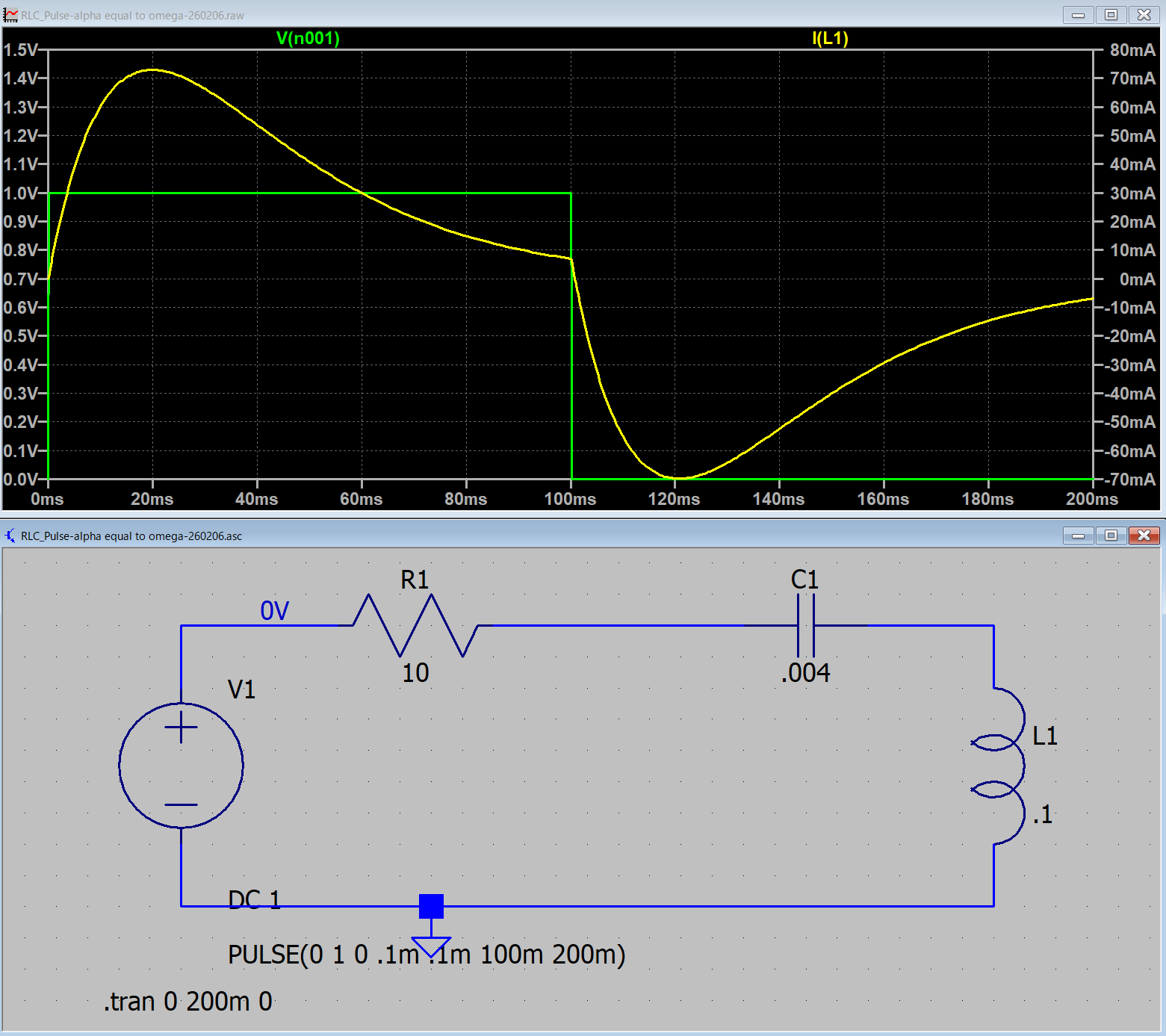
実際に,LTspice,でシミュレートしてみましょう.ここ,と同様に,
V0 : 1 V
R : 10 Ω
L : 0.01 H
C : 0.0004 F
とすると,
\(\Large \displaystyle \omega_0 = \frac{1}{\sqrt{0.01 \times 0.0004} } = 50 \ (1/s) \)
\(\Large \displaystyle \alpha \equiv \frac{10}{2 \times 0.01} = 50 \ (1/s) \)
となり,α = ω0,の条件となります.
\(\Large \displaystyle \omega = \sqrt{ \alpha^2 - \omega_0^2 } =0 (rad/s) \)
となり,LTspiceでシミュレートすると,
となります.式と当てはめてみると,
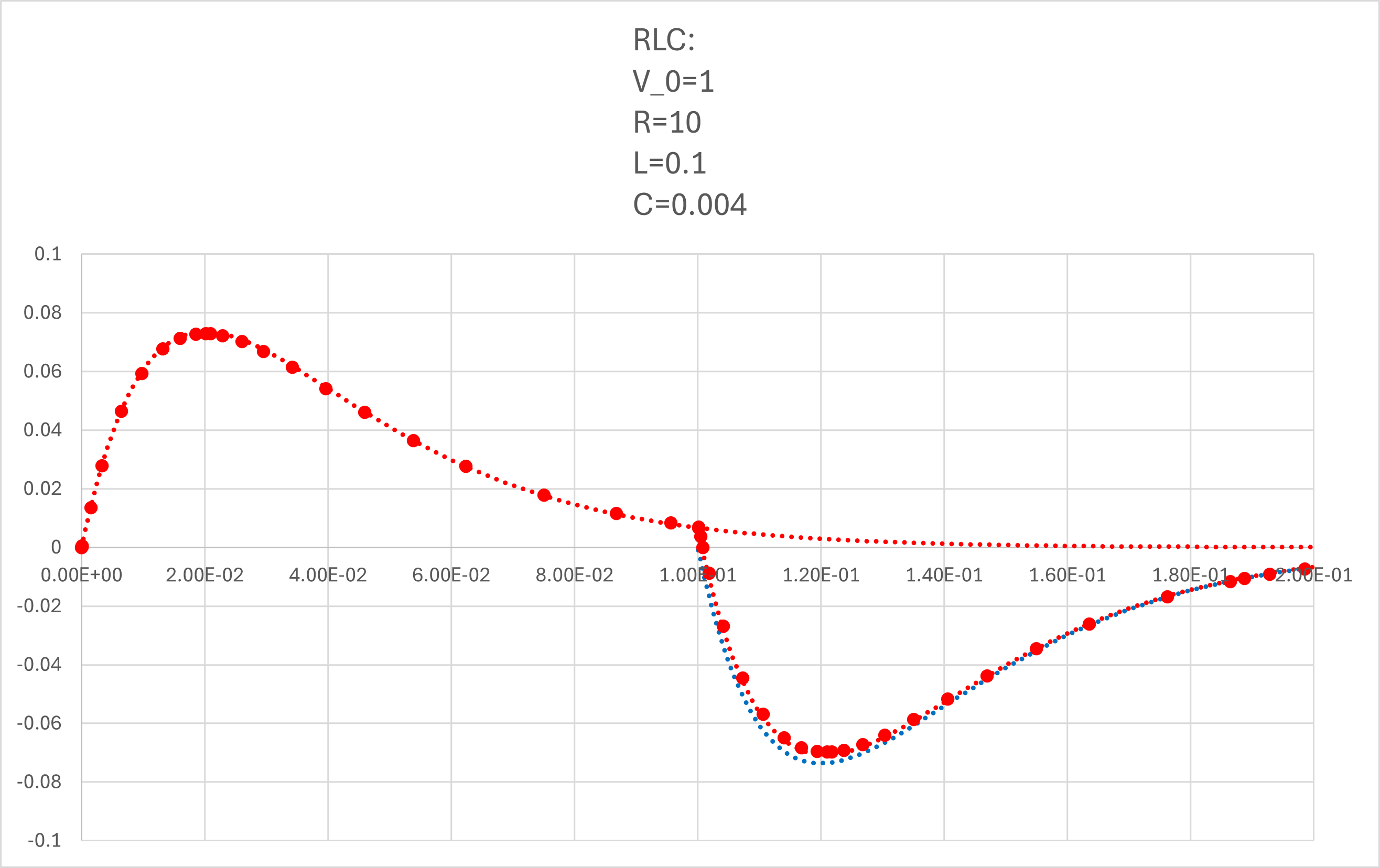
と一致することがわかります(全領域で).
青点線,が右辺第二項,で右辺第一項との和が,シミュレーションと一致することがわかります.


